Around Garstang you will notice there are several blue plaques, each marking a historic location. You will see all the plaques if you follow the heritage trails around the town.
You can follow the Heritage Trail around Garstang by collecting a leaflet from the library on Windsor Road, or download a copy below:
There is also a Pub Trail around the town, which takes in the sites of former pubs, as well as those that still exist. You can follow this trail by collecting a leaflet from the library on Wiondsor Road, or download a copy below:
Barnacre View Cottages

Barnacre View Cottages are set back from the road behind a small garden. These early 18th Century cottages formed part of the common lodging houses, and a drover’s road would have gone from here down to the river nearby to let the cattle drink.
The Corn Mill
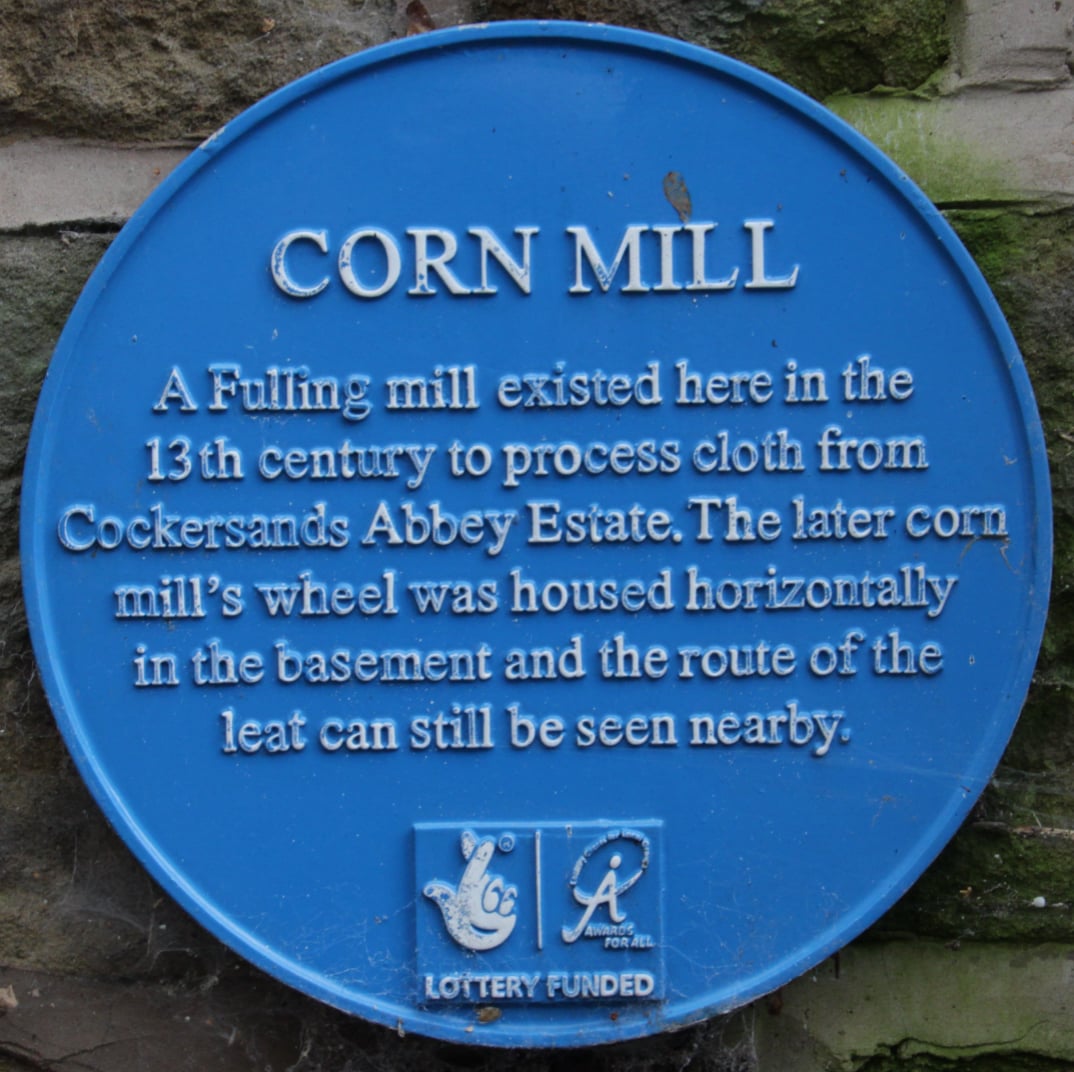
A fulling mill existed here in the 13th century and processed cloth from Cockersand Abbey estate. The Abbey housed Premonstratensian monks (also known as White Canons) who relied heavily on sheep farming for economic survival. They would use the sheep to provide meat, milk and wool.
Wool from the Abbey would have been sent for fulling, a process that increases the thickness and compactness of woven or knitted wool by subjecting it to moisture, heat, friction, and pressure to shrink the wool and produce a smooth, tightly finished wool fabric that was light, warm, and relatively weather proof. The fabric could then be used to make the monks’ robes and other items for use in the monastery.
The monastery was closed in 1539 during Henry VIII dissolution of monasteries.
Sometime later the mill became a corn mill and operated as such for over 300 years. Unusually the mill wheel was housed in a tunnel under the building rather than on the outside as was common.
The Corn Mill is now a nursing home, and many of the original mill features have been retained.
Garstang Inns – the Eagle and Child

The Eagle and Child was one of the town’s two Posting Inns which provided board and lodging,and also stabling, and fodder for the traveller’s horse(s), plus fresh horses for the Mail coach. Built of stone and slate it had 8 bedrooms and a brew house. It also had extensive stabling at the rear. The public house was enlarged in the late 18th Century and again in early 1912.
The inn sign refers to the legend of the Eagle and Child, which is attached to Lathom near Ormskirk. When
Thomas Stanley, the first Earl of Derby – who built Greenhalgh Castle – acquired the Lathom estate, he incorporated a representation of the Eagle and Child legend into his coat of arms.
The legend of the Eagle and Child is attributed to Sir Thomas Lathom.
Sir John Stanley married Isabel Lathom in 1385. Isabel was the daughter of Sir Thomas Lathom, who owned lands at Lathom near Ormskirk and also at Knowsley near Liverpool. Isabel inherited the Lathom lands on the death of her father, and they became part of the Stanley estate.
Sir Thomas Lathom had many illegitimate children, one of whom was called Oskatel. He is said to have hidden Oskatel under a tree, in which there was an eagle’s nest, and then took his wife on a walk so that they found the abandoned child. Thomas persuaded Isabel that they should adopt the child, which they did.
When the Stanley family inherited Thomas Lathom’s estates on his death they incorporated the eagle and child (Oskatel) into the family crest. Many pubs on the Lathom estate were called Eagle and Child, and the Garstang one is among them.
Chapel House/Weind House

This building with it’s arched windows was built as a Catholic Church and Priest’s House in 1788. Now private housing the building has been a social centre, cinema and Law Courts.
Court cases were heard at the Town Hall until 18th May 1893 when the first case was heard at the new court.
The Preston Chronicle of 20th May 1893 reports:
On Thursday morning the Garstang Petty Sessions were held for the first time at the Institute, and although not so centrally situated, the new Court House is a decided improvement on the venerable Town Hall. As it is used for dances and festal occasions the floor is waxed.
The place has been repainted, and around it are hung a number of small shields, and what with them and the stage the effect is somewhat theatrical. Prisoners are kept in a small room at the rear of the hall, so that when called upon they are paraded past the public.
Market House

Originally built as a Corn Exchange by Mr. F. W. Keppel, the Lord of the Manor, at his own expense.He said that no toll or charge was to be made upon the grain sold in the exchange, wherever it came from.
The first stone of the new Corn Exchange was laid at Garstang on Thursday 16th October 1845, and the Exchange opened on Thursday 27th November 1845, despite the building being incomplete. But as it was raining it was decided that it could be used, and the opening was attended by many merchants and others.
The building was used to house the town fire engine after it ceased to be a Corn Exchange.
The building is still in use today, and now houses the Indoor Market. The original prison cell still remains and is now used as an office by the Market Superintendent.
The Oldest Cottage on the High Street

Number 42 High Street is the oldest cottage on the street, and was originally a thatched, cruck built cottage. It was rebuilt in 1984 and during the works the timbers were carbon dated to 1590.
The cottage is situated near the eastern end of what was the old Rope Walk. The rope was made in front of a long row of stone and thatched buildings, which went roughly from Nickson’s Weind and along where Windsor Road now stands.
The Wool Pack/Pack Horse/Temperance Hotel

The building was built to replace an older premises with the same name around 1800 – 1810, and the Keppel family Crest was carved onto a stone plaque on the gable end of the building.
During the mid 1800’s the Pack Horse had room to stable 29 horses, stallion houses where stallions and mares were brought for mating, a shippon for 5 cows and a brewhouse. At the rear of the inn there was a garden and a bowling green.
The inn was sold by the Keppel Estate in 1877, and was closed in 1905 when the publican had his licence revoked.
It then became a Temperance Hotel for a time, before finally closing in 1923. In 1925 it became the Manchester and County Bank.
Garstang Weinds

Garstang’s ancient weinds are narrow alleyways running off the High Street which date from medieval times.
They often changed names to match the adjoining shops. Thomas’s Weind was originally named Horabin’s Weind after the family who owned the property from the early 18th century. In the mid 19th century it passed into the ownership of Jonathan Jowett Thomas, the first of the Thomas line of chemists who traded in the town for many years and gave their name to the Weind.
Stoops Hall Weind is named after Stoops Hall, the building next to it which was built in 1882. The name ‘Stoops’ originates from a type of building, which rested on ‘stoops’ or posts’.
Many of the weinds have large archways which would have given access for horses and coaches to stables at the back of the High Street. Garstang was on the main coaching route between London and Scotland and was a place to stop and change horses, as well as allow passengers to get refreshments before the next part of their journey.
The bottom of Nickson’s Weind was the site of the old Cattle Auction, which was in use until 1923.
Town Hall

The Town Hall is situated next to the Market House, in Market Place, Garstang. The building was opened in 1680, but unfortunately burnt down in 1750.
It was rebuilt in 1755 but was again badly damaged by fire in 1939.
The flames spread very quickly and soon extended throughout the building, but the heroic efforts of the fire brigade prevented it extending into the market hall next door, and to other nearby buildings.
Saved by firemen from a locker on the first floor were documents relating to the Charter of Incorporation granted on August 6th, 1680 by Charles II. The original Charter of Incorporation was granted to the town by Edward II in 1314. This Charter was surrendered in 1680 when Charles II granted a new one with increased privileges.
In addition to the Charter, documents and the old minute book, other historic articles which were saved from the blaze included a gallon measure bearing the inscription “Imperial Gallon Garstang 1826”; a pair of handcuffs, two halberds; the market bell, and a statue of Queen Victoria.
All these items are still in the possession of the Town Trust, apart from the statue of Queen Victoria.
The town’s ancient stocks were unfortunately lost in the blaze. These were kept in a small gallery above the main room and could not be reached. They were destroyed with a number of chairs, equipment and library books belonging to the British Legion.
Most of the Georgian stone work remained after the fire, and it was incorporated into the rebuild. The clock tower was a later addition to the building, and was erected thanks to public subscriptions in 1847.
Above the entrance to the Town Hall are two stone panels commemorating the Jubilees of Queen Victoria and Queen Elizabeth II.
Wyre Bridge

The original stone bridge was built by the first Lord Derby in 1492. The present bridge was built in 1629, and widened in 1829 and again in 1929. There are two arches to the bridge and at one time there were
There are passing places on the bridge where pedestrians could stand in safety while traffic passed.
In the river by the bridge was a weir and a salmon ladder which made an easy route up for the salmon and sea trout to swim up the river to their spawning grounds. It also enabled the numbers of fish going up to the spawning grounds to be monitored.
The weir was blown up in 1961 as part of the work to straighten the course of the river under the bridge. The weir provided water for the Corn Mill beside the river but was no longer needed when the mill closed.
Old Post House

In 1785 the original building was a milliner’s shop, making hats for the population of Garstang and the rural district.
It was rebuilt around 1810, and served as the central hub for mail distribution and royal mail deliveries for the town from 1858 till 1922 when the Post Office operated from 39 High Street.
Arts Centre
Arts Centre
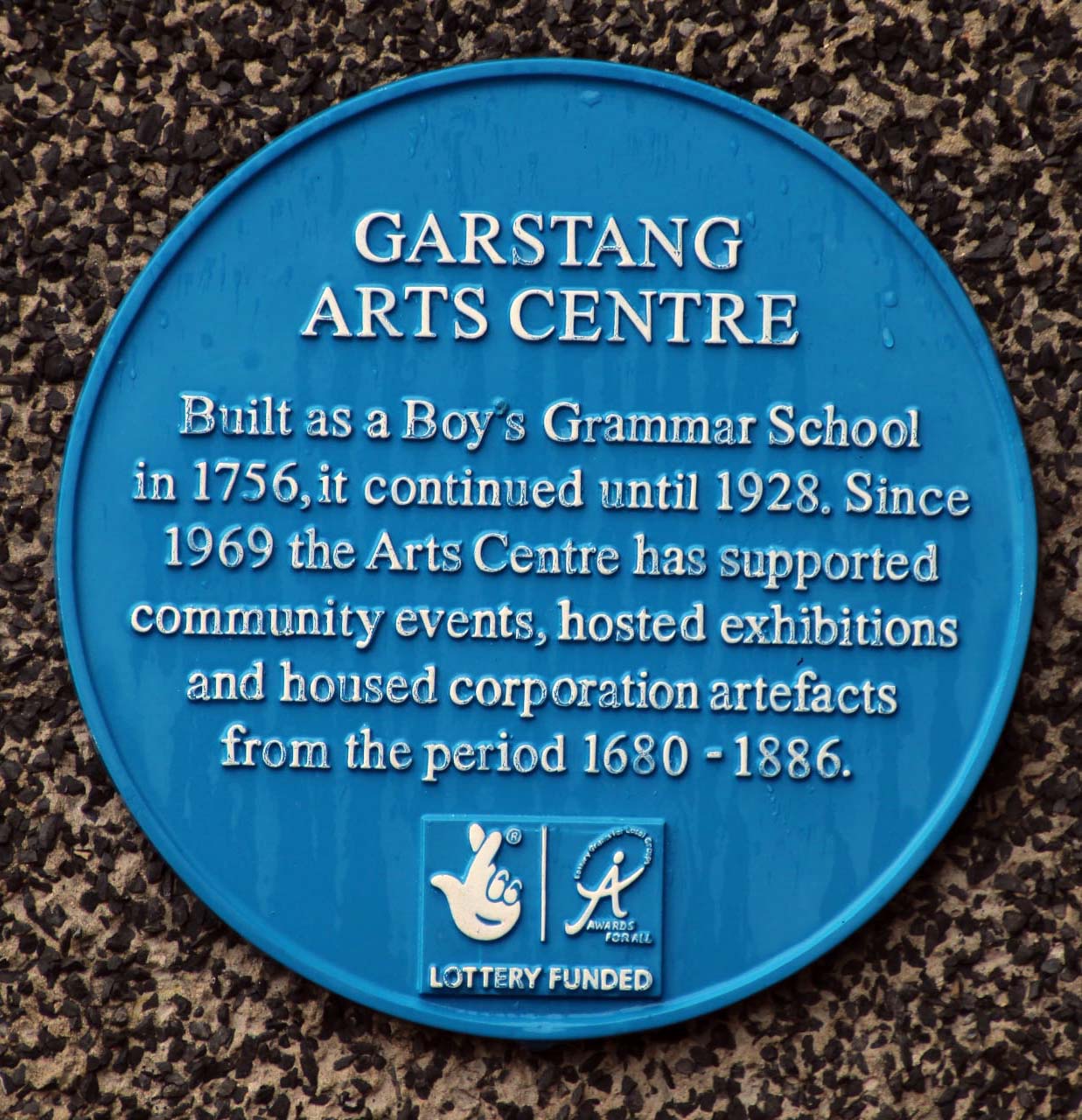
The front part was originally the Boys Grammar School. It was built in 1756 and closed in 1928. The building is now held by Garstang Town Trust and serves the local community, supporting numerous interest groups and hosting exhibitions and events.
It houses in the old school room memorabilia of old Garstang Corporation which includes two halberds (axes dated from 1886), an Imperial one gallon measure, Town Crier’s bell, Town Sergeant’s truncheon, handcuffs and branding iron.
The building stands on land granted to “the Mayor and Corporation of Garstang” by Sir Edward Walpole for a term of 200 years at an annual rent of 2s and 6d. Mt John Morland of Winmarleigh gave £150 for the endowment of the school. When the building was ready for use the money was handed over to the Mayor and Corporation. The Corporation made an annual allowance of £6 15s which was handed to the Schoolmaster. In return he had to give free tuition to four scholars selected by the Town Bailiff.
Liberal Club
In 1882 the Liberal Party wanted to hold a meeting at the Institute in Back Lane to promote the party. However, the Institute rules did not permit the premises to be used for political purposes.
A committee meeting was held to decide on a change to the rules to allow such meetings, and was voted through, and a meeting of the Liberal Party was scheduled for 1st June 1882. However the trustees then decided that such a rule change should not be allowed and on the day of the meeting they barricaded the doors. The Liberals then had to hold their meeting at the Town Hall.
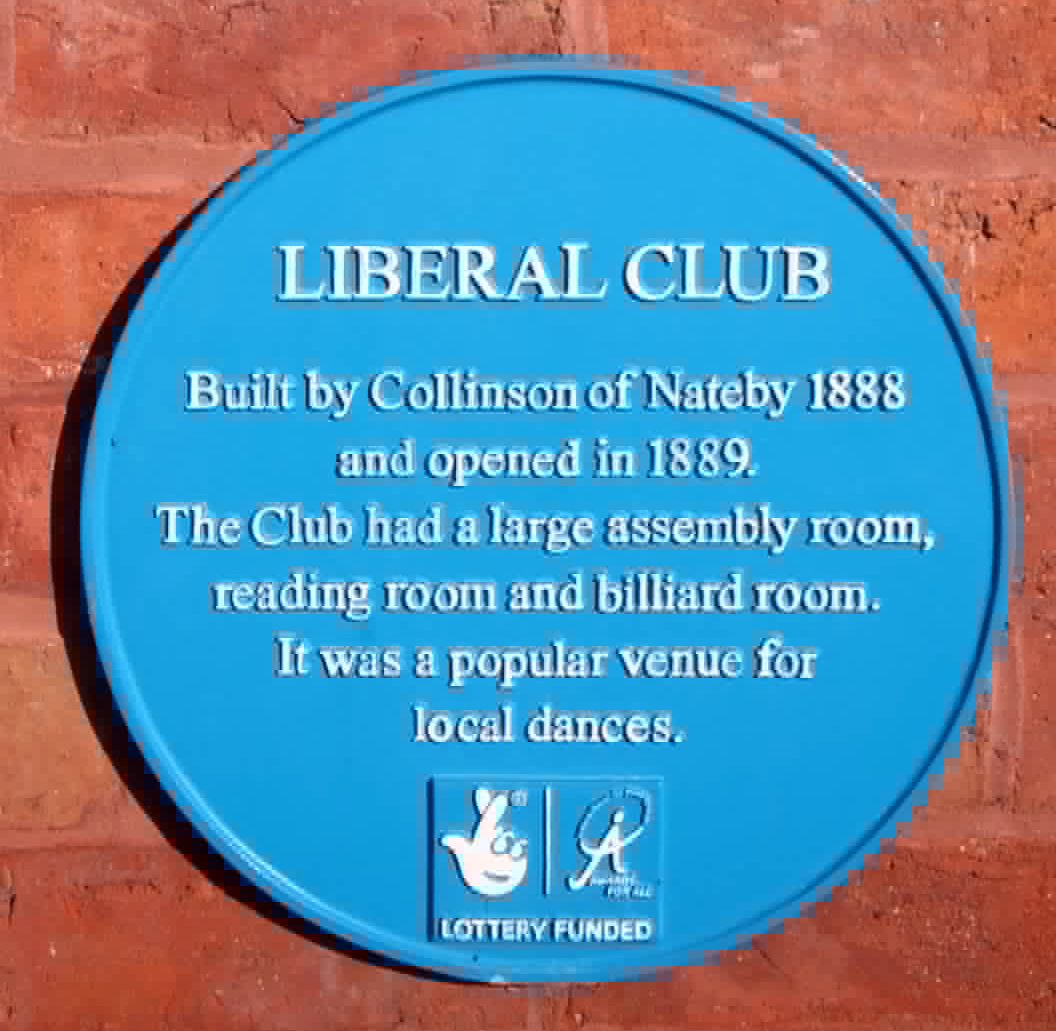
As a result the Liberals built their own premises on Bridge Street. The foundation stone was laid by James Williamson, the Liberal MP for Lancaster on 25th October 1887. He returned to officially open the building on the 18th February 1889.
The Liberal Club had a large assembly room upstairs, and a reading room, committee room and billiard room on the ground floor. It was a very popular location for local dances.
The building is currently used as office accommodation.
The Mustard Seed
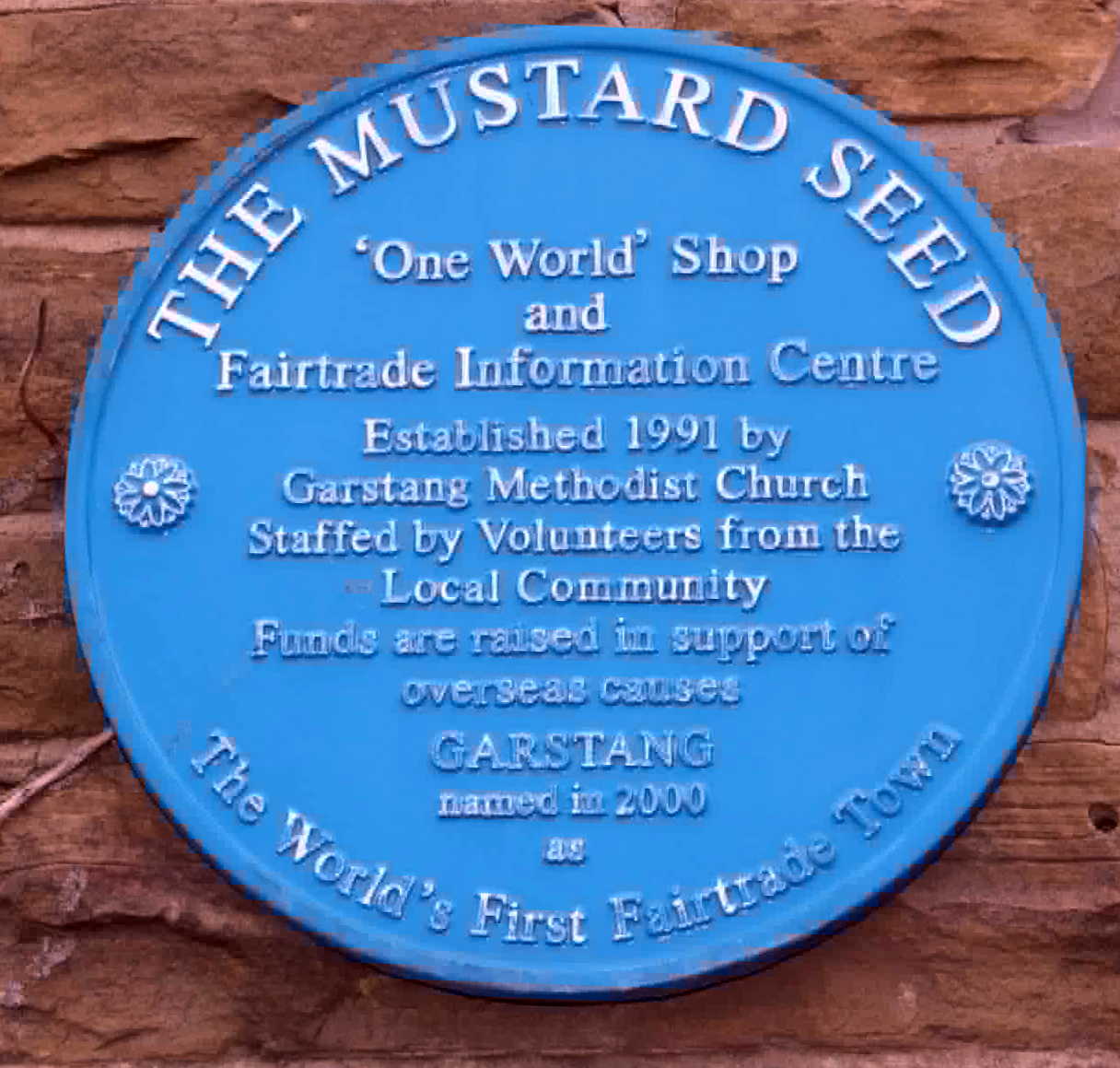
At a public town meeting on Thursday 27th April 2000 the people of Garstang voted for Garstang to become the world’s first Fairtrade Town.
While visiting Garstang, George Foulkes, the then Under Secretary of State for the Department of International Development said “The beacon that has started here in Garstang can spread like wildfire across the whole of the country and beyond.”
Now, with Fairtrade Towns throughout the United Kingdom as well as many other countries across the globe, his prediction has proved correct.
In November 2001 Tony Robinson, of Blackadder and Time Team fame, unveiled a plaque (on the wall of the former Council Offices) to commemorate Garstang as the world’s first Fairtrade Town.
Harriet Lamb, Director of the Fairtrade Foundation then presented the first Fairtrade Town certificate to Garstang’s Mayor to launch the Fairtrade Town initiative to the world. Garstang’s first fair trade retailer was The Mustard Seed, which opened in 1991.